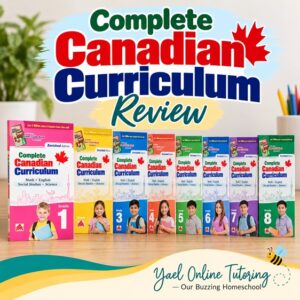
I often get questions about these popular workbooks: The Complete Canadian Curriculum. With their catchy title, they’re definitely appealing, but let’s see what they really offer and when they’re most helpful—or not.
A note about the newer edition: In 2025, the publisher released the Enriched Edition of The Complete Canadian Curriculum. According to the publisher, the content has only minor changes, while the new edition features updated covers and includes a Smart Guide Book. My review is based on the editions I’ve used.
✅ COMPLETE
YES, these books cover all major subjects (math, English, science, and either social studies or geography/history, depending on the grade).
NO, they don’t fully align with the Ontario curriculum. For instance, the English sections have minimal grammar and spelling, while the math sections don’t fully cover key topics like fractions, algebra, and complex word problems.
🇨🇦 CANADIAN
YES, the content often highlights Canadian history, culture, and geography.
NO, there’s no single Canadian curriculum. Each province sets its own learning expectations, although by the end of middle school, students cover pretty much the same material in core subjects.
👩🏫 CURRICULUM
YES, the books cover most topics included in the Ontario curriculum, but only at a basic level.
NO, they don’t provide enough depth to replace comprehensive instruction. Each topic gets only a few pages with basic tips and hints. This might be enough to refresh existing knowledge, but not to fully grasp new concepts. Plus, there’s little to no review or connection between chapters. On top of that, the exercises offer virtually zero opportunity to develop logical reasoning and critical-thinking skills.
So, who are these books good for?
- Refreshing general knowledge before the school year starts or during summer review (this is what I use them for with my daughter).
- Getting a quick snapshot of your child’s knowledge and skills in core subjects before starting homeschooling.
- Newcomer or ESL students who need to build basic academic vocabulary and become familiar with terminology and task wording.
- Students who need to work on their reading comprehension and vocabulary in English.
For other situations, I would recommend more comprehensive resources.
That said, while the Complete Canadian Curriculum series does include books for preschool and kindergarten, I don’t find those particularly useful. At such an early age, children need to work on their motor skills as well as structured instruction for early literacy and handwriting. During the kindergarten years, children are expected to learn proper letter formation and develop decoding skills rather than relying solely on tracing whole words or guessing their way through reading. Encouraging children to guess instead of learning to decode can reinforce ineffective learning habits.
During our preschool years, we used some books in Russian, as well as Kumon and Learning Without Tears workbooks.
I’m planning to share more curriculum reviews, so subscribe to my newsletter and follow me on social media to stay in the loop! If there’s a particular curriculum or resource you’d like me to review, let me know in the comments.