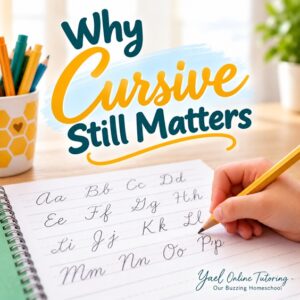
Yes, even in the age of AI and all kinds of digital devices, knowing how to write in cursive is still relevant. In fact, I think teaching only print handwriting leaves children without a practical, efficient form of handwriting that they may need later.
Handwriting Is Good for the Brain
Research shows that writing by hand engages the brain in ways that typing does not. And if we are going to keep this useful skill, I think it makes sense to teach children a form of handwriting that allows the hand to move continuously and efficiently.
Think of it as physical exercise. There was a time when gyms didn’t exist — people stayed physically active simply because everyday life required it. Today we have to deliberately exercise because modern life doesn’t give us enough opportunities to use our bodies.
I think handwriting is going through the same transition. We used to write because we had to. Now technology has made it possible to get through much of our daily lives without writing by hand at all. But just because we don’t have to use a skill every day doesn’t mean we should stop developing it.
Why Cursive?
Writing in print is certainly an option, but it is slower and more tiring because it is less ergonomic. Cursive allows for a more continuous movement of the hand, making it much more efficient for longer stretches of writing. My students always get excited when they learn their first letter and can write it without looking in the very first session!
That is one of the reasons I believe cursive is still worth learning.
There are also several practical benefits:
🧠 Taking Notes by Hand
When learning something new, handwritten notes can be an effective way to actively process and retain information rather than simply recording it or taking a screenshot.
And with cursive, you can write continuously while still following what is happening on the board or in a presentation.
🔋 No Battery Required
What if you need to write something down and your device is dead?
Pen and paper still work!
💌 Cards Still Matter
Signing a card or writing a personal note by hand is simply beautiful — and often much more meaningful to the person receiving it.
📖 Don’t Forget About Reading Cursive
Children may encounter handwritten notes, cards, letters, family recipes, historical documents, and other materials that aren’t written in print. Being able to read cursive is a useful literacy skill even if they don’t use it every day.
Cursive in Ontario Schools
Cursive writing was reintroduced as part of Ontario’s revised Language curriculum in 2023, beginning in Grade 3. From my experience with my students, I also know that, on a practical level, many teachers struggle to implement cursive instruction in a systematic and efficient way.
Although handwriting isn’t my main subject, I successfully taught my daughter to write in cursive a couple of years ago, and occasionally work on it with my homeschool students. So I want to share what worked for us, along with some resources.
A Few Practical Tips
✏️ Start With Pencil Grip
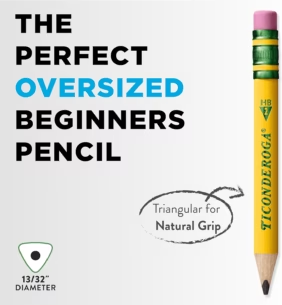
A proper pencil grip is very important because it allows a child to write with minimal effort.
If your child hasn’t developed a good pencil grip yet, it’s worth paying attention both to overall upper-body development and to fine-motor skills.
Short triangular pencils can be very helpful for developing an efficient pencil grip and building a good habit. There is a good selection on Amazon. See on Amazon (affiliated link) →
📚 Choose a Systematic Cursive Program
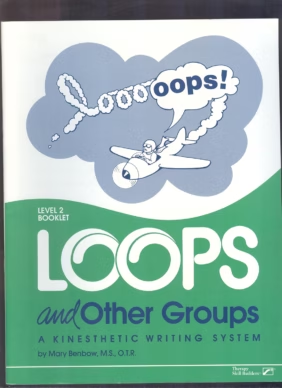
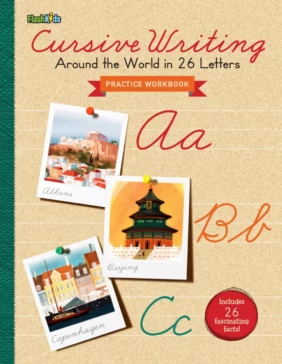
We tried several different cursive workbooks, but in the end, the two shown in the photo below were the ones that worked best for us.
Loops and Other Groups is a very systematic program that teaches letters in groups based on similar movement patterns, with plenty of practice for each letter. I especially liked that it focuses on the actual movement of the hand, not just what the finished letter should look like.
See on Amazon (affiliated link) →
Cursive Writing – Around the World in 26 Letters combines handwriting practice with geography. Children practice letters, words, and sentences while learning about countries, their capitals, and landmarks. So you get handwriting practice and a little geography lesson at the same time. Win-win! 🌎✍
See on Amazon (affiliated link) →️
So, Is Cursive Still Worth Learning?
Children don’t need to spend hours every day practicing beautiful penmanship. But I do think cursive deserves a place in their education. Print gives children one way to write; cursive gives them another — one that can be faster, more continuous, and useful for both writing and reading handwritten material.
Cursive also gives children a chance to use their brains and hands in a way that typing simply doesn’t replicate.