


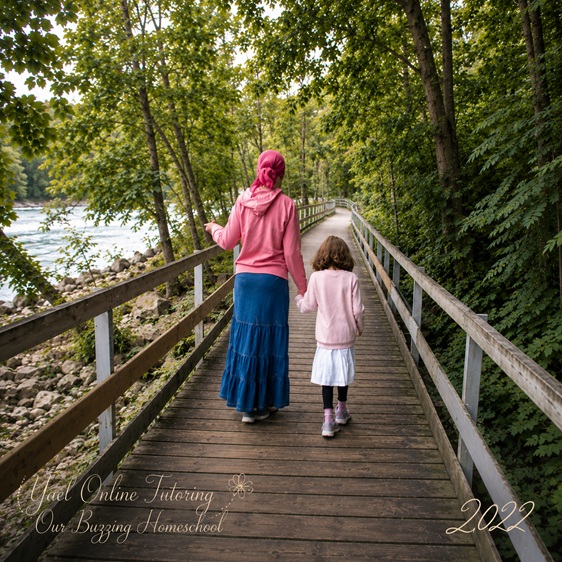
There are so many questions that pop up when you first start thinking about homeschooling. What are the pros and cons? Can homeschooling work for a child with additional health or developmental needs? While every family is unique, I hope our story will help you gain a new perspective and make the right decision for YOUR family.
Why Does Our Family Homeschool?
The short answer is that it works best for our daughter, for her physical and mental health, learning, and development.
Not because it’s easy or my daughter is an excellent student (ha-ha), or we have a big house or a great support system or extra $$$ in our bank account.
We are a family of 3 living in an apartment in Toronto, Ontario. We have been homeschooling since 2017, so by now we have quite a few years of experience with this lifestyle.
My husband and I are blessed with a spirited, highly sensitive, talented little girl who also happens to have some neuro-developmental challenges and health conditions, including Type 1 diabetes. We don’t have any family support here in Canada.
On the other hand, it was probably easier for us to choose alternative education for our daughter for a few reasons.
We Never Had a Traditional North American School Mindset
Both my husband and I are originally from Russia, so spending six hours at school every day starting in the early grades was never something we considered the only “normal” way for children to learn.
We also believe that school should primarily be about learning. Socialization is important, but we don’t think it has to happen strictly in the classroom or at school all day. Children can socialize in many other places and through activities based on their family’s lifestyle and their own interests.
Only now, as adults, have we started to truly appreciate some aspects of the educational system we grew up with. Academically, some parts of it seem similar to the Charlotte Mason approach, at least for the early years, with more focus on building a strong foundation for learning skills — something that makes even more sense to us now in light of what we understand from neuroscience — rather than the short-term memorization often used in classrooms.
We Have Never Lived on Two Full Incomes
During my first year in Canada, I was learning English, volunteering, and freelancing a little bit. Then our daughter was born.
She has always been a high-needs baby, so I had to give up all my projects even before we started our medical journey at SickKids Hospital. Since then, her physical and mental health, rehabilitation, and overall development have been my main project.
We Have Different Standards for Academics
I was exploring different career opportunities when my daughter was in daycare. It turned into volunteering at the community Homework Club for a few years.
I was tutoring students in Grades 4–12, mostly math, but also some English grammar as well as various projects.
I was extremely surprised by the low expectations and the amount of busy work in math. Children’s attitudes towards learning were also alarming.
My family is determined to provide our daughter with the best education possible for her, especially as it’s quite clear that her career choices would be limited due to her health condition.
So, the more we learned about the public school system, the less appealing it looked to us.
Private schools are way beyond our family budget, so we have never considered this option and settled on homeschooling.
What Do We Get From Homeschooling?
A Flexible Lifestyle and Environment
A schedule and environment supporting physical and mental health — eating, sleeping, using the washroom, moving around, and taking breaks whenever a child needs them.
We also have parental control over sensory overload and screen time (I was surprised to find out my daughter’s daycare used screens for fun!).
Learning at Her Own Pace
We don’t have to push too far too early according to school standards that are just average at best and not developmentally appropriate in the worst-case scenario.
We can create a customized learning plan, working around our child’s strengths and weaknesses to provide a well-rounded education.
More Opportunities for Development and Talents
Free play, sensory play, outdoor time, and regular targeted early intervention and therapeutic activities in our case.
We also have more opportunities to pursue talents that are not included in the school curriculum — languages in our case.
Cultivating a Lifelong Love of Learning
We want to teach independent learning skills so she can teach herself whatever she needs as an adult.
I personally had to learn TONS of new things as an adult that I would never, ever have imagined I would need. And I am so very grateful for the research and learning skills I have.
Learning Life Skills
Cooking and nutrition, budgeting, logic, critical thinking, and other skills that are difficult to learn from textbooks alone.
Real-Life Social Skills
Learning to communicate with different people and under different circumstances while parents are usually around to guide and support — doctor’s offices, customer service, delivery companies, people from all walks of life in parks and museums.
Quality Over Quantity in Social Life
As homeschoolers, we have an opportunity to choose our child’s social circle.
You have to be intentional and creative with this, especially if you have an only child and no cousins living nearby. But you also have an opportunity to teach your child how to navigate different situations and protect your child from bullying.
The last one is a particular concern for me since my daughter acts differently, is weak and slow physically, but is also very kind and naive. As you can see, she is a perfect candidate to be bullied.
My husband and I had a few episodes where we had to physically protect her from other children at a very young age.
Those kids are just typical kids who got annoyed by my quirky daughter, which I totally understand, trust me.
But unfortunately, typically developing children are not usually taught how to deal with “different” children or at least adequately supervised during their social interactions.
And even if they are taught about differences, they usually picture a child in a wheelchair or severely autistic, not a bubbly girl who is a bit clumsy and makes silly comments, right?
A More Relaxed Lifestyle
Last but not least — a more relaxed lifestyle, fewer sick days, a lovely family bond, relationships, and memories.
But Homeschooling Has a Price Tag Too
All of the above probably sounds like a dream plan, but there is a price tag for this.
Homeschooling Requires Work
And it’s not teaching, as many people think, but rather prioritizing, planning, organizing, and budgeting.
It’s totally doable but not easy, especially at the beginning, until you find YOUR rhythm and style.
As a side note, teaching is actually quite easy to outsource, and there are even some free options online and in the libraries.
Homeschooling Can Mean a Loss or Decline of Income
Homeschooling often means a loss or decline of income, potential income, career opportunities, or retirement savings, especially if children are young and can’t stay home by themselves and learn independently.
But, on the other hand, homeschooling does not require active parent involvement from 9 a.m. to 4 p.m., 5 days a week, so you might be able to find some alternative part-time or work-from-home options to contribute to the family budget.
You might also be able to save or completely cut some expenses like gas, a second car, camps, and after-care if one parent stays home.
A decline in family income may also affect your eligibility for certain tax benefits, child benefits, or subsidies for community programs.
Homeschooling Burnout
Staying at home with children 24/7 and always being “on duty” could be draining.
To avoid burnout, you need to build a support system, learn to let things go, and learn to listen to your body.
To make this lifestyle sustainable, you need to become more intentional and put not only kids’ activities but also “filling my cup” time into your schedule.
I’m so grateful to all the mental health professionals who worked with us throughout my daughter’s medical journey for changing my mindset and helping me become a better parent.
So, Why Do We Homeschool?
Homeschooling isn’t easy, and it certainly isn’t perfect.
But for our family, the flexibility and individualized education it provides are worth the work and the sacrifices.
We homeschool because, for our family and our daughter, it works.









One Response
test