As you might know, in addition to homeschooling my daughter, I also tutor school-aged kids. So I see firsthand how crucial a solid foundation is. When children struggle in Grades 2 and 3, it’s rarely because they can’t memorize formulas, usually it’s because they missed out on early number sense.
There is a common misconception that early math has to look like worksheets to be “real” learning. It doesn’t. Early learning looks like play, but that is exactly what makes it so incredibly powerful.
A multisensory, hands-on approach usually works best for young children, as they have not developed abstract thinking yet. Start slowly to build a solid foundation—the best investment in your child’s math!
With my daughter we took an unschooling approach in the early years, and here are some hands-on, zero-prep, and mess-free ideas for incorporating math into your everyday life.
This list is pretty long, but you DON’T HAVE to do it all at once or even in one month. It would actually be counterproductive. It takes time to grasp each concept, not just memorize it.
My rule of thumb is to move to the next step only when the child has mastered at least 80% of the previous step.
And keep reviewing all previous steps on a regular basis.
Steps for Building Number Sense
1. Counting Forward
-
When setting the table, count the same number of plates, forks, strawberries, or whatever else for each family member.
-
While doing laundry, count socks, shirts, towels, etc.
-
Count how many steps it takes to get to the kitchen, jumps on the trampoline, etc.
-
Use various building toys.
2. Counting Backwards
-
Count steps, demolish LEGO towers, take things out of a basket, etc.
-
Traffic lights are also great for this.
It’s important to take your sweet time mastering this skill—it is a stepping stone for subtraction and eventually division.
3. Connecting Number Words, Numerals, and Quantities
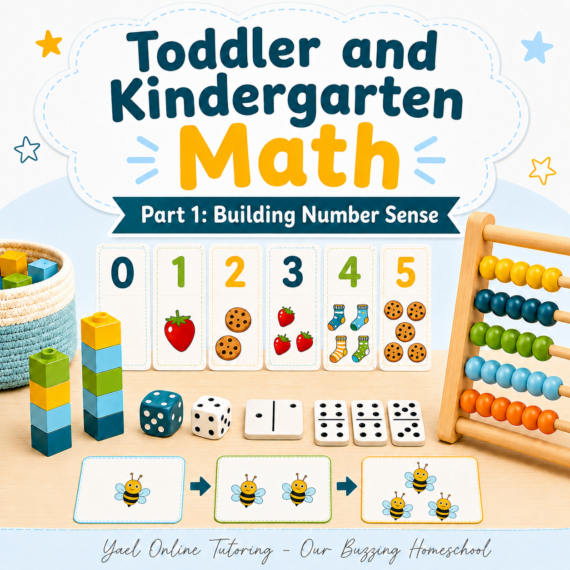
Connect number words — zero, one, two — with numerals — 0, 1, 2 — and quantities.
I do recommend starting with zero and explaining that it means nothing—an empty basket, box, etc.
-
Point out numbers in children’s books and on packages.
-
Draw or show a card or block with a number and ask the child to bring the same number of LEGO blocks, apples, etc.
-
Then do it the opposite way: build a tower and ask the child to say the number and find a card with that number.
-
Play board games: bingo, lotto, dominoes, matching games, puzzles, and Snakes and Ladders.
-
Practice subitizing—recognizing how many items are in a small set without actually counting them. Dice and dominoes are perfect examples.
4. Comparing
-
Build two LEGO towers using, for example, three yellow and five red blocks. Then ask: Which one is taller? If I add one more yellow block, how many will there be? Which one will be taller? What if I add one more?
-
Practice in various situations to build a deep understanding of the concept. Use other toys, or compare apples and bananas, green and blue socks, etc.
5. Ordering
This is similar to Step 4, but use more groups.
Don’t forget to alternate tasks—from biggest to smallest and vice versa. It will help train a child’s brain to pay attention to details—another important math and life skill.
It will also solidify the idea that if one thing is bigger, another is automatically smaller.
Eventually, remove the objects and use only numbers. I used flashcards and blocks for this.
And treat every mistake as an experiment. If a child says, “Five is less than three,” build two LEGO towers together to see whether it’s true or false.
A Quick Reminder: math doesn’t have to be a chore or a formal planned event. By choosing these no-prep, mess-free moments throughout your day, you are making math a natural part of your child’s world.