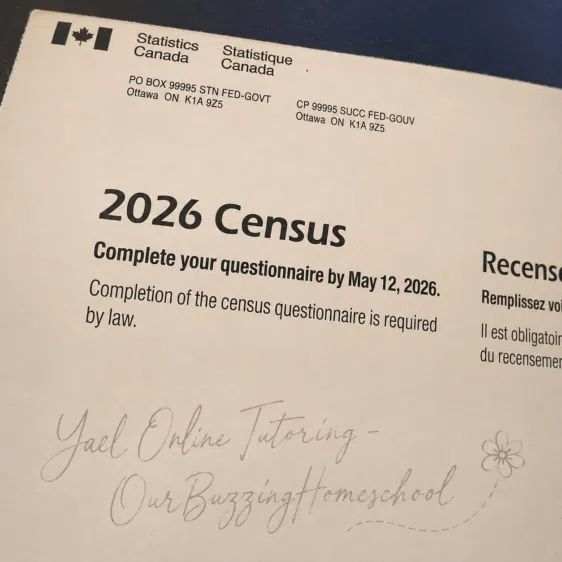
When the yellow 2026 Canadian Census envelope arrived in our mailbox last week, our homeschooling instincts immediately kicked in.
Homeschooling allows us to turn everyday experiences into meaningful learning opportunities, and this became an unexpected real-life social studies and civics lesson for our family. As a new Canadian, I am still learning alongside my daughter, so we decided to dig deeper into what the Canadian census actually is — and why it matters so much for families and communities across Ontario and Canada.
After reading through official information and many social media discussions, I realized that many people are not fully aware of how census data directly affects our daily lives.
All information below is gathered from public sources and shared for educational purposes as part of our homeschool social studies research project.
What Is the Canadian Census?
Statistics Canada conducts this survey every five years, regardless of which political party is in power at the provincial or federal level. By law, completing it is mandatory.
A couple of past censuses coincided with health issues for both my daughter and mother-in-law, when I was filling out so much paperwork for them at the time that I honestly lost count. Since we never received follow-up calls or visits from inspectors, I assume we managed to submit them. This time, though, we decided to approach it more intentionally.
Keep in mind that there are two types of forms: a short-form census (for everyone) and a long-form census (sent to every fourth household for more detailed demographic data).
Is the Census Confidential?
Government agencies (CRA, Immigration, School Boards, Service Canada) and social media already know everything about us — and maybe a bit more. 🙂 But Statistics Canada data reflects communities as they exist right now, not several years ago. That makes it especially useful for planning services in rapidly growing and changing areas. And while the agency can pull information from other departments (to save us from answering extra questions), the law strictly prohibits them from sharing your personal census data with any other organization. Interestingly, Statistics Canada’s confidentiality protections are often described as being even stricter than medical confidentiality, since medical records may sometimes be released in emergencies or through court orders.
How Census Data Impacts Everyday Life
This was probably the most interesting part of our homeschool social studies discussion. This information helps the government decide how to allocate existing public resources and budgets. Based on demographic data, planners can better understand what different neighborhoods and communities actually need.
Libraries and Community Programs 📚
Whether to stock the local library with books in Hebrew or Mandarin, and what languages to use for children’s Story Time or seniors’ book clubs.
Medical Services 🏥
If there is a need for specific language interpreters in local hospitals or for home care services.
Very personal questions directly influence the planning of culturally sensitive community health programs like women’s clinics, mental health counseling, and more.
Schools, Transportation, and Community Planning 🚌
Where to build new schools and playgrounds, where to place senior residences with culturally sensitive programming and dietary preferences, and where to add new bus routes.
As regular visitors to two children’s hospitals, my daughter and I complete demographic surveys several times each year. We have personally seen how statistics help shape specialized pediatric programs and services. A few years ago, we were fortunate to get access to a specialized rehabilitation summer program within walking distance from our home!
But if families and communities are not fully represented in the data, the system may not recognize the need for specific local services.
Census 2026 Deadline Info
The suggested deadline for completing the 2026 Canadian Census questionnaire is
May 12, 2026. However, even after that date, households are still legally required to complete it. Statistics Canada may send reminder letters or follow up with phone calls and in-person visits to ensure every household is counted. The census can be completed online through the official Canadian census website.
And if you did not receive or misplaced your 16-digit secure access code, you can still request a new one online.
Real-Life Learning
Sometimes the best homeschool lessons come from ordinary moments in everyday life.
What started as a yellow envelope in our mailbox turned into a meaningful conversation about how communities function, how services are planned, and why participation in public systems matters — especially for families with children, seniors, newcomers, and people with diverse needs.
And honestly, those are the kinds of social studies lessons that tend to stay with children much longer.